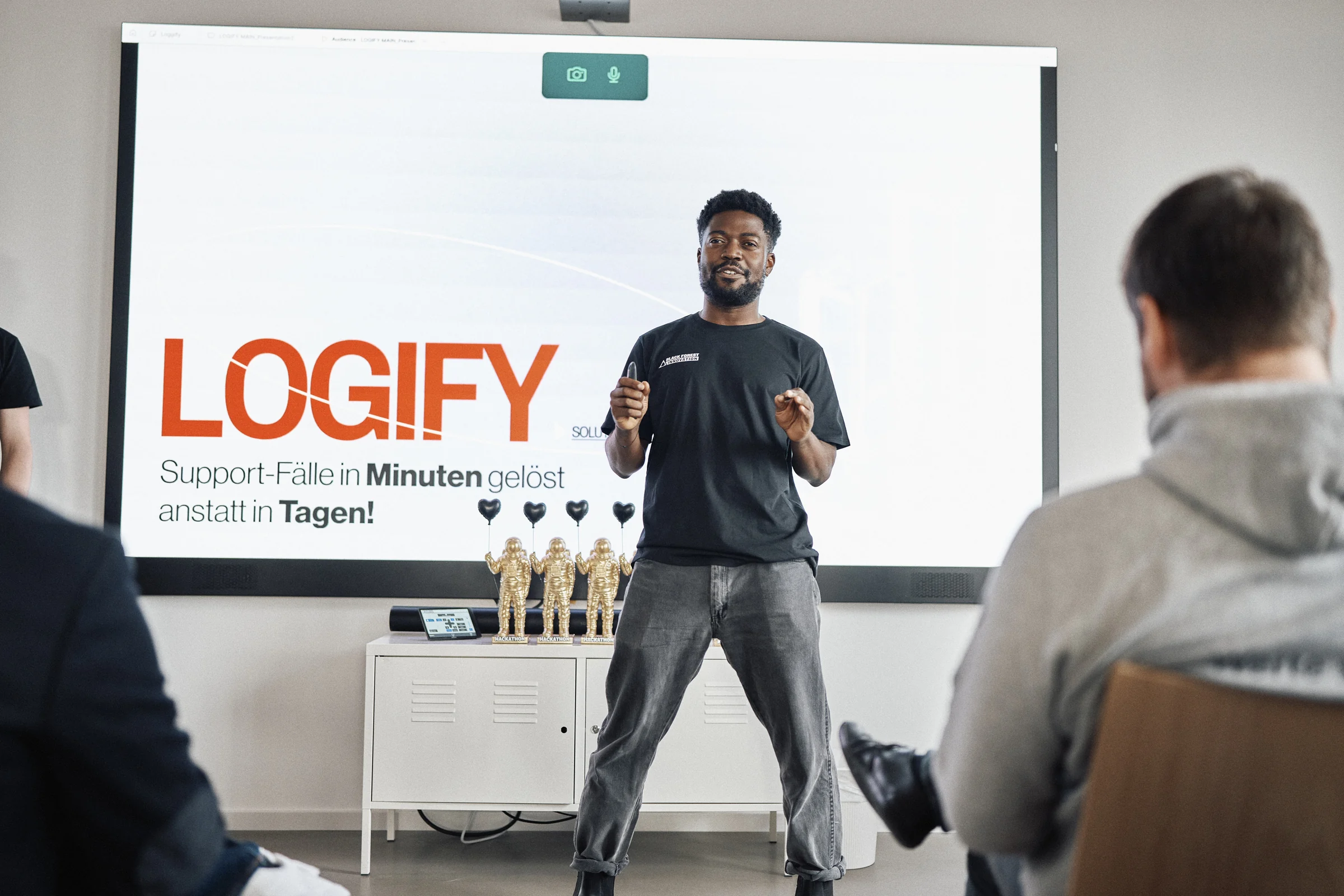
Whoever decides on AI training in a company does not want to see a full auditorium, but a change that pays off. With us there is a deployable prototype and an impact report at the end, not a folder full of slides. The training moves a budget, not an attendance list. We plan scope, challenges, roles, data, tool access and the run of show so the training can be ready to start within one week. What ships and when depends on the agreed scope.
Audience: leadership, department heads and HR who want to embed AI broadly and prove the value.
AI training for a company enables the breadth of the workforce to use AI productively and proves the value on real results. In our format a facilitated hackathon produces deployable prototypes plus an impact report and a documented AI literacy measure, instead of a certificate with no measurable effect.
The problem leadership actually has
Classic training is expensive attendance without effect. For leadership four problems stack up that a seminar day does not solve: the transfer is not measured; the ROI is barely provable; the breadth never happens as a few frontrunners know the tools while the rest work as before; and the Article 4 duty stays open when a seminar cannot show actual competence. We prefer to think in breadth, not a few standout experts. A hundred employees who actually run the AI tools in daily work move a company further than ten showcase experts while the rest of the workforce never gets started. AI training for a company should enable the breadth, not a few specialists.
What the company training includes
We build the training around the tasks that cost the company real money or real time. Business teams from several areas work in parallel on their own challenges with Cursor, Lovable, n8n, Gamma, Figma Make, Claude Code and Custom GPTs. It starts with a tool workshop, then the guided sprint, and ends with pitches and a handoff to IT and the business side across four stations: cross-department scoping of the highest-value challenges, tool workshop, parallel build sprint, and pitches with impact report and handoff.
Learning goals and benefits for the company
The goal is a change you can lay out for leadership: enabled breadth instead of a few frontrunners, measured by usage not attendance; 3 to 5 deployable prototypes plus an impact report that weighs value against effort; a tangible starting point for your own ROI measurement; and a documented AI literacy measure toward EU AI Act Article 4 that serves compliance and productivity at once.
Who it fits, and who it does not
| Good fit when | Not a fit when |
|---|---|
| leadership wants to prove value, not just document attendance | a plain attendance record without effect is enough |
| AI should be embedded in several areas | only a single person should be upskilled |
| data and tool access can be approved across areas | data and tools stay locked company-wide |
| there are owners in the areas who continue after the sprint | no one takes responsibility afterwards |
Deliverables
Cross-department scoping of the highest-value challenges, a curated tool stack per challenge including access, a facilitated tool workshop and parallel build sprint with support, 3 to 5 deployable prototypes across areas, an impact report weighing value against effort per prototype, a handoff package per prototype for IT and the business side, and documentation of the AI literacy measure for all participants.
Formats
| Format | Duration | Participants | For |
|---|---|---|---|
| Spark | 1 day | up to 10 | one deployable prototype for one area, internal proof |
| Ignite | 2 days | 10 to 15 | several areas in parallel, impact report, broader anchoring |
| Blaze | 3 to 5 days | 15+ | company-wide rollout, production-ready prototypes, clear path |
Pricing on request for now.
AI training vs. AI hackathon
| Criterion | Classic AI training / seminar | AI hackathon |
|---|---|---|
| Output | certificate, attendance record | deployable prototypes plus impact report |
| Learning mode | lectures, slides | hands-on with real data and tools |
| Reach | a few frontrunners | breadth of the workforce enabled |
| ROI evidence | barely provable | tangible artifact as a starting point for your own measurement |
| Documentation | record only on paper | documented literacy measure with real results |
| Time to first result | weeks to months | ready in 1 week, outcome depends on scope |
For leadership the ROI evidence row is the decisive one. Reliable figures only come from your own baseline. Full comparison on AI training vs. AI hackathon.
How the company training can add up (a model, not a client number)
ROI comes from your own figures, not a borrowed case number. Three inputs and one formula: weekly time for a recurring manual task per area, the share a deployable prototype realistically removes, and internal hourly rate times affected people across areas. Formula: hours saved per week times hourly rate times 45 working weeks times people, minus the one-off cost of the training and rebuild weeks. If a task costs five hours per person per week, three areas with eight people each are affected and a prototype removes 40 percent each, you get an order of magnitude you can lay out for the board. We run exactly this in the discovery call with your real numbers. Interactive calculator: /en/ki-schulung/tools/roi-calculator/.
Social proof
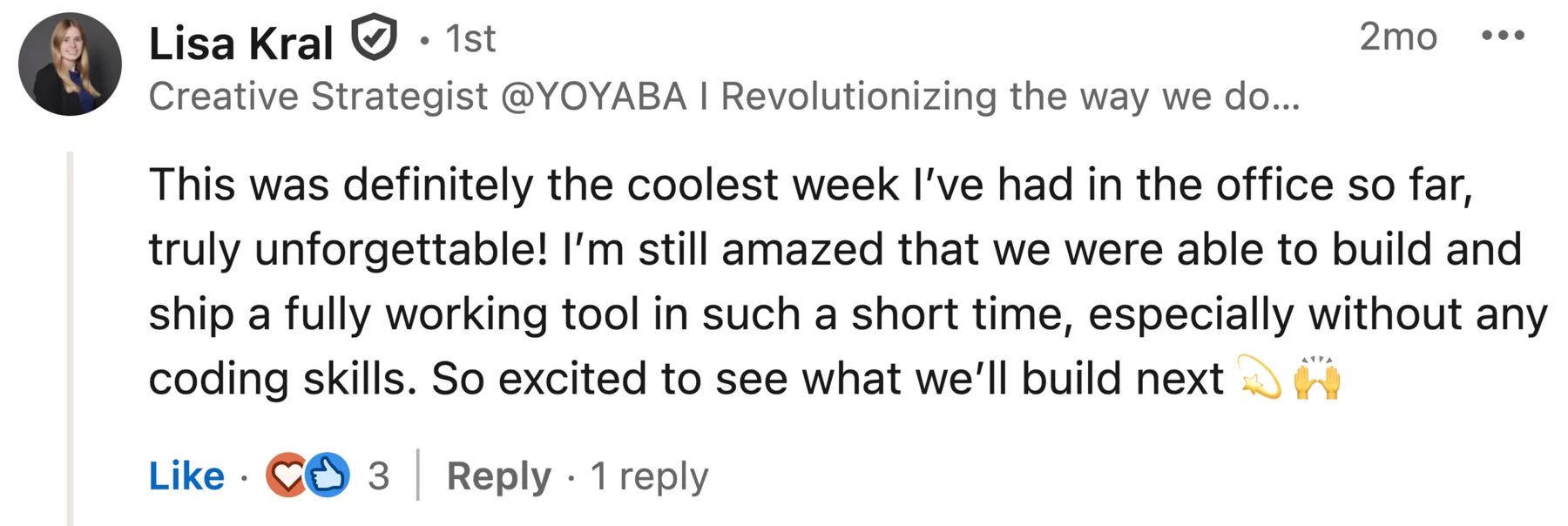
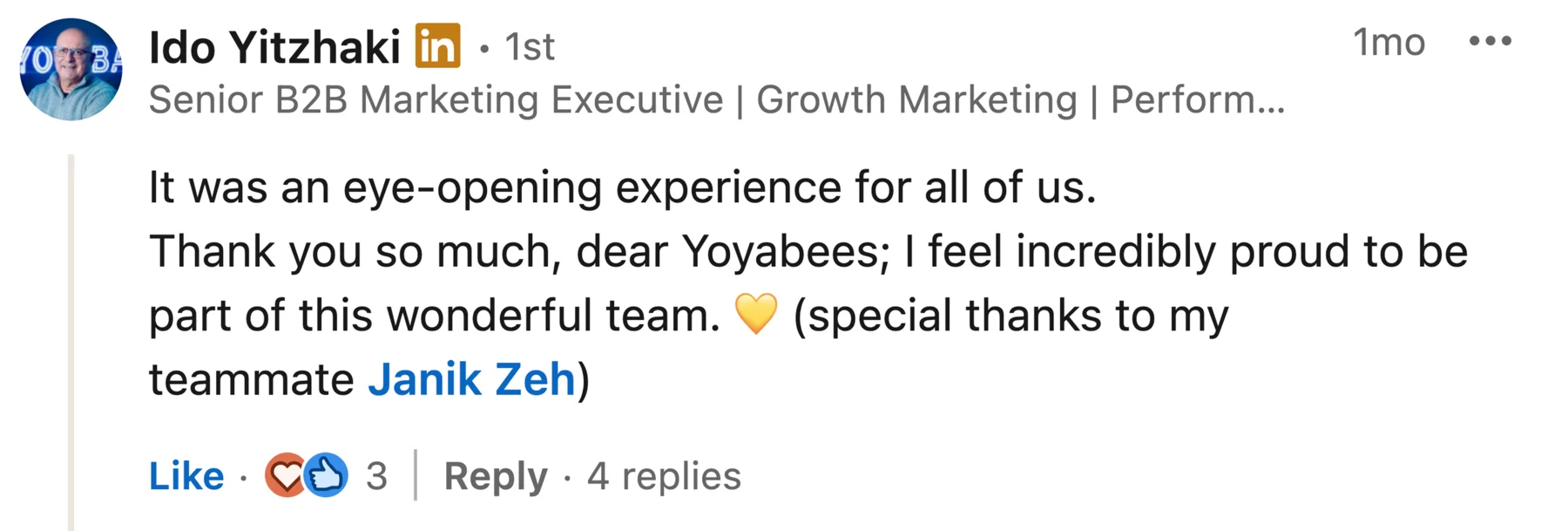
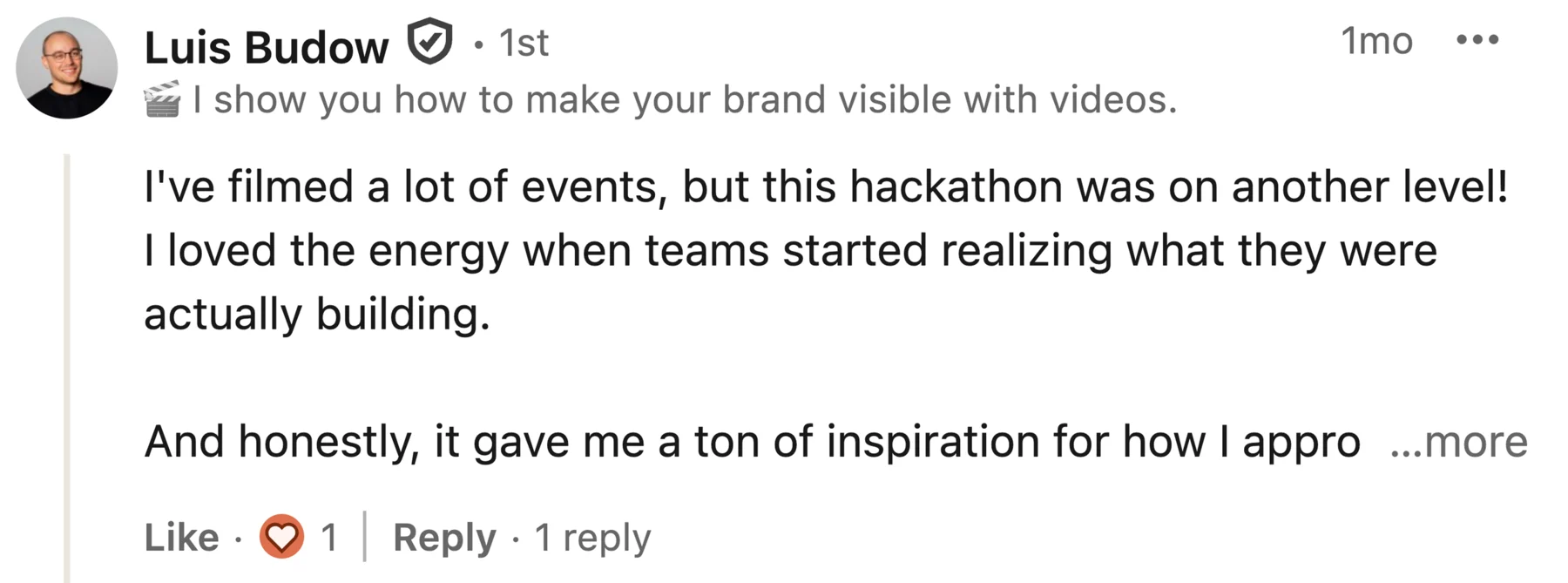
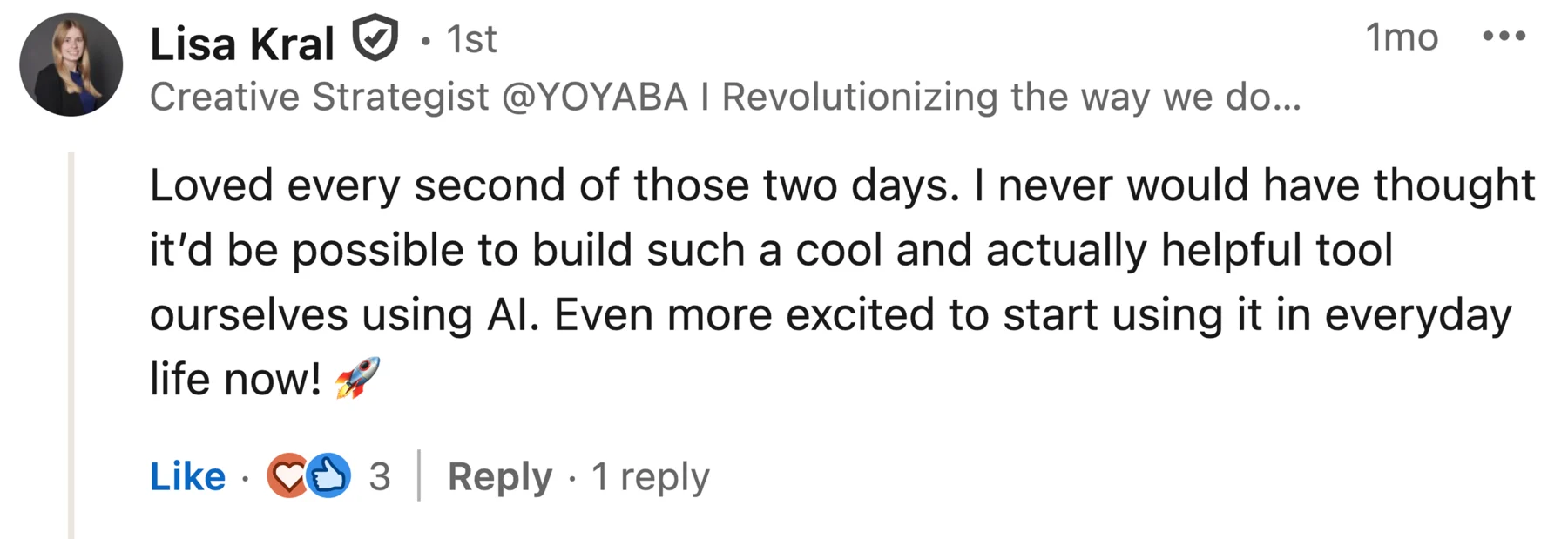
Teams from companies such as YOYABA, Onventis and NavVis have worked with us. Names, logos, workshop photos and public feedback from these teams are in the case studies.
FAQ
How do we prove the ROI of AI training? Through the projects created. At the end there are 3 to 5 deployable prototypes plus an impact report that weighs value against effort. Unlike a seminar, the result is tangible and can be laid out for leadership concretely. Reliable figures come from your own baseline.
Is this worth it for a whole company or only for one team? For both. Blaze runs across several departments with parallel teams, the AI Enablement Program accompanies the company over 3 to 6 months. The logic behind it is breadth, many enabled people beat a few specialists.
Can the AI training support documentation under Art. 4 EU AI Act? The format can contribute as one role- and context-appropriate AI literacy measure and create an internal record. It does not automatically satisfy Article 4. The organisation must assess its overall programme for the relevant roles, systems and risks.
Do the prototypes stay usable after the hackathon? Yes. The prototypes are yours and keep running on your systems. Each comes with a handoff package to an owner so IT and the business side can carry it into production. For deeper production-ready solutions there is the follow-on implementation sprint.
How much does AI training for a company cost? The price depends on format, duration and team size. We do not put flat prices out yet, because every engagement is tailored differently. You get a concrete quote in the discovery call at https://cal.com/jamboula/ai-hackathon.
How fast do we see results? From first contact to the first running prototype takes one week. A first working state forms early in the sprint, the deployable prototypes at the end. Outcome and delivery time depend on the agreed scope.
Legal note: A hackathon and the competence record described here can document practical AI literacy measures, but they are not an officially mandated certificate and do not automatically guarantee compliance with Article 4. The company must assess its overall program for the relevant roles, context and risks.