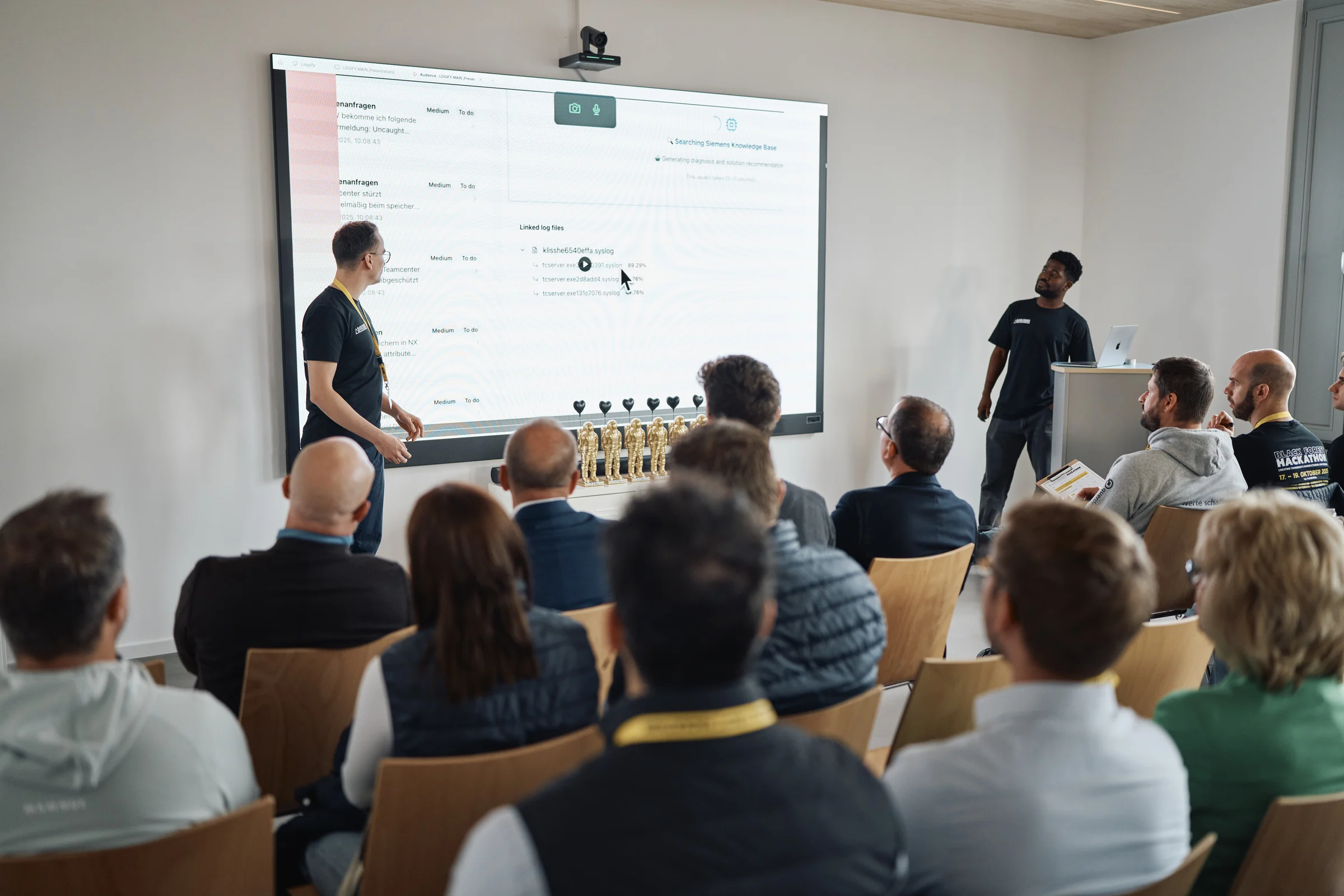
Author and editorial responsibility
Tim Jamboula, Founder of Corporathon. Last reviewed 24 August 2026.
Summary
Most AI training creates a short motivation spike that flattens after two to four weeks. Adoption only holds when application is anchored in daily work, with a real process, an owner and a success criterion. Choosing a hands-on sprint over a lecture lifts the curve because learning and application happen in the same moment.
Table of contents
- The real question behind "adoption"
- The four levers that hold adoption
- The 30-day adoption curve
- Decision framework: what lifts your curve
- Honest cost logic
- A worked ROI example (model)
- EU AI Act: adoption as a competence record
- What to do next
- FAQ
1. The real question behind "adoption"
"How do we train our staff on AI" is the wrong question if the answer is "which seminar do we book". The better question: what will your people do differently in four weeks? Adoption is a behaviour change, not a knowledge level, and behaviour changes through repeated application on real tasks, not through listening.
You do not measure adoption by the applause after the session, but by the usage four weeks later. – Tim Jamboula, Founder of Corporathon
2. The four levers that hold adoption
| Lever | Without it | With it |
|---|---|---|
| Real process | practice on demo data, no transfer | application on the own case from day 1 |
| Owner | no one carries it forward | one person holds usage and handoff |
| Success criterion | "interesting", not measurable | time, errors or throughput measurably better |
| Repetition | one impulse, fades | usage anchored in a weekly rhythm |
3. The 30-day adoption curve
Visualisation: active usage after the session (schematic, illustration without measured values).
Usage
 high|x x
     |    x x                               hackathon cohort
     |         x  . . . . . . . . . . . . .  (usage stays, because it is anchored)
     |          .    x
     |         .        x
     |        .            x
     |       .                x  x  x  x  x   lecture cohort
     |      .                                 (motivation flattens out)
 low +----------------------------------------> Time
     Day 0     Day 3   Week 1   Week 2   Day 30
4. Decision framework: what lifts your curve
Four questions, answered honestly, say where your adoption lands.
- Do people apply what they learned within a week on real tasks? If not, plan application in firmly or choose a sprint.
- Is there an owner who tracks usage? No owner means no repetition, and no repetition means no adoption.
- Is success measurable? Without a metric, nobody notices whether it works or fizzles.
- Is usage embedded in a weekly rhythm? A one-off session with no follow-up is a flash in the pan.
Three or four "no" answers mean a lecture alone will not hold adoption, a hands-on format is the better lever.
Build adoption that is still there four weeks later
Two paths, depending on your starting point.
- Book directly: Book a discovery call. 30 minutes, we look at how you anchor usage instead of just training.
- Read first: Enter your email and get the adoption playbook excerpt. No spam, unsubscribe any time.
5. Honest cost logic
A training day rate is rarely the expensive part. What is expensive is what happens after the session, or fails to.
- Format choice. A lecture is cheap per head, but expensive if adoption fizzles.
- Preparation. A sprint needs scope, data approval and access, that is effort and value at once.
- Follow-through. Owner time and a weekly rhythm are real costs, without them the return drops.
- Rebuild. A prototype heading to production needs hardening weeks.
We quote prices personally. The right scope emerges in conversation, from these variables.
6. A worked ROI example (model)
Purely illustrative model. Twenty employees who use AI tools after training save 90 minutes per person per week, but only for as long as usage holds.
- At 40 percent held adoption: 8 people × 1.5 hours = 12 hours per week.
- At 80 percent held adoption: 16 people × 1.5 hours = 24 hours per week.
- Difference across 45 weeks: (24 − 12) × 45 = 540 hours per year.
- At a 55 EUR internal hourly rate: roughly 29,700 EUR of modelled annual value from the higher adoption alone.
The figure is not a guarantee and not a client number. It shows that it is not the training itself but the held adoption that drives the return.
7. EU AI Act: adoption as a competence record
Since 2 February 2025, Article 4 requires sufficient, role-based AI literacy. Practical application is easier to document than pure knowledge; a used artifact shows competence concretely. This can evidence a measure but is not an official certificate and does not guarantee automatic compliance. The company itself must assess whether this is adequate.
8. What to do next
Stop measuring adoption by applause. Anchor application on a real process, name an owner and a success criterion. If you want high, durable usage fast, a hands-on hackathon is the more direct path, one week from first contact to prototype, because learning and application coincide.
Next step
- Book directly: Book a discovery call. We plan adoption on a real process.
- Read first: Enter your email and get the adoption playbook. Double opt-in, unsubscribe any time.
Related terms
AI adoption · AI hackathon · AI training vs AI hackathon · AI training agenda · AI literacy
FAQ
Why does AI training often fade after a few weeks? Because knowledge without application drops quickly, the forgetting curve. Without a real process, owner and repetition, there is no occasion to use what was learned.
How do I measure adoption concretely? By usage and result: how often a tool or prototype is really used and whether a measurable metric improves. Applause is not a measure.
Does a hackathon drive more adoption than training? It anchors application from day 1 on the real case, so usage tends to hold longer. It does not replace basics if a team starts from zero.
Must all employees attend? No. Focused teams with a real case create more durable adoption than a broad group without a concrete task.
Legal note: Documented AI usage from training or hackathon can evidence AI literacy measures, but is not an officially mandated certificate and does not automatically guarantee compliance with Article 4.