Short definition
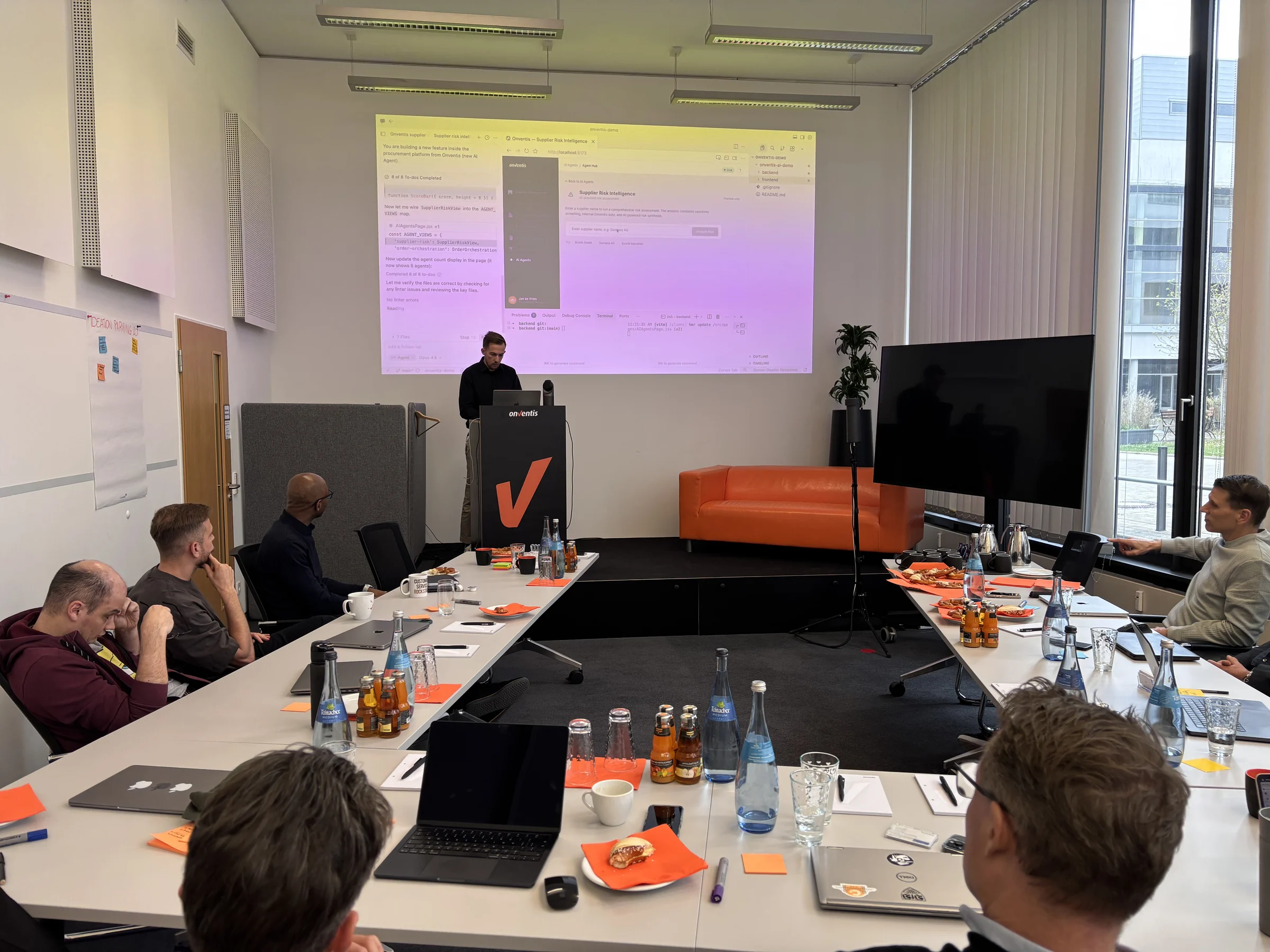
In-house AI training is AI upskilling delivered for a single company and within its environment. Content, examples and exercises build on the company's own roles, tools and approved data. Unlike an open seminar with mixed participants, the format is tuned entirely to one organisation's context and real tasks.
Where the term comes from and how it shifted
In-house training is an old term from corporate learning. For a long time it simply meant the place. A provider came to the company instead of staff travelling to an open seminar. The benefit was logistics and cost control for larger groups. With AI the emphasis shifted. The real value today lies not in the place but in the context. A generic AI seminar shows example prompts on other people's cases. What a team actually needs is application to its own documents, tools and data rules. Only a format built for one company can deliver that. So with AI training, in-house is no longer a logistical detail but the lever for relevance and transfer.
The mechanism: why your own context lifts transfer
Training rarely fails on content and often on transfer. Seeing a prompt on a made-up example in an open seminar teaches the principle but never applies it to your own, often sensitive case. In-house training closes that gap by working with real tasks from the start.
Open seminar               In-house AI training
------------               -------------------
other people's examples    your own processes and documents
   |                          |
principle understood       practised on the real case
   |                          |
(transfer gap back home)   result already fits daily work
   |                          |
maybe applied              used with familiar data and tools
Two effects arise only in the closed setting. First, confidentiality. A team can discuss real, sensitive cases because no outside participants are in the room. Second, shared group dynamics. When a whole department learns the same language and templates, a shared standard emerges that outlives the session.
A worked mini-example
An illustrative cost model for 15 people. Figures and prices stand as variables, not a flat price, because the real cost depends on the provider, the scope and the location. Open seminar: price per seat times 15 people, plus travel and time out per person, scaling linearly with headcount. In-house: a day rate for the format, largely independent of the exact group size, plus internal preparation of your own cases. Tipping point: above a certain group size, in-house becomes cheaper per head, and the relevance advantage comes on top. These numbers are a model, not a quote. The point is the structure: open seminars scale with headcount, in-house with effort, and the real difference is the fit to real tasks, which is hard to price in euros.
Use cases by function
| Function | Tailoring of the in-house training | Typical result |
|---|---|---|
| Marketing | own channels, tone and briefs | shared prompt templates for content |
| Sales | real offers and CRM fields | patterns for follow-up and prep |
| HR and recruiting | own job and process templates | drafting help with human review |
| Finance and controlling | real report structures | analysis and summary patterns |
| IT and support | internal systems and data rules | safe use with clear limits |
| Leadership | role-based approvals and governance | shared standard for the team |
Industries that prefer in-house formats
Demand rises with data sensitivity and process specificity. In finance and insurance and in health and pharma, the closed setting is almost mandatory, because real cases do not belong in an open seminar and data rules must be taught alongside. In engineering and industry, the own context pays off because expertise and documentation are highly company-specific. In larger mid-market firms and corporates, group size alone makes in-house economical. Marketing agencies choose in-house when a whole team should adopt the same way of working and the same templates. The common denominator is that relevance and confidentiality matter more than the lowest per-seat price.
Distinction from related formats
| Format | Characteristic | When it fits |
|---|---|---|
| In-house AI training | closed, tailored to one company | when own data, processes and confidentiality matter |
| Open seminar | mixed participants, generic cases | when a few individuals need an entry point |
| Online self-paced course | flexible timing, no facilitation | when baseline knowledge at your own pace suffices |
| Train the trainer | internal multipliers are enabled | when knowledge should be passed on internally |
| One-on-one coaching | one person, highly individual | when a key role needs focused support |
When in-house is worth it, and when not
It is worth it when a group should learn the same way of working together, when real and partly sensitive cases should be practised, and when the own tool and data context is central. It is worth it less when only one or two people need a first overview, where an open seminar or online course is the cheaper route. An honest fit before booking saves budget, because in-house only pays off above a sensible group size and with a clear own use case.
In-house AI training and the EU AI Act
Since 2 February 2025, Article 4 of the AI Act requires providers and deployers to ensure a sufficient level of AI literacy among staff, measured against role and context of use. An in-house format has an advantage here, because it can be tailored to your own roles and systems and documented with recorded content for the right audience. It is a possible building block and internal evidence, but not an official certificate and no guarantee of compliance. The company assesses the adequacy of its overall programme itself.
Next step
Two ways, depending on where you are.
- Book directly: Book a discovery call. 30 minutes, we look at your group size, roles and use cases and tailor an in-house format.
- Read along first: Enter your email and get the in-house readiness checklist plus a template to prepare your own cases for the training. No spam, unsubscribe anytime.
FAQ
From how many people is in-house AI training worth it? It depends on the price structure, but as a rule of thumb in-house becomes cheaper per head than an open seminar from a mid-size group upward, often around eight to ten people and above. Regardless of price, the relevance advantage from your own cases always applies.
Can in-house training happen remotely? Yes. In-house means the closed setting tailored to one company, not necessarily a physical place. The format works on site, remote or hybrid. What matters is that it works with your own roles, tools and cases.
Do we have to provide our real data? Not necessarily full production data, but the value rises with closeness to the real case. Often approved examples or anonymised extracts suffice. Data access and limits are settled beforehand with IT and privacy and belong in the training.
How does it differ from an open seminar? An open seminar mixes participants from different companies on generic examples. In-house training works in a closed setting on your own processes, which allows confidentiality and makes transfer into daily work much easier.
Is this legal advice? No. Regulatory questions require review of the specific facts and current law by qualified counsel.
Related glossary terms
AI training · Practical transfer · Copilot training · ChatGPT training · AI literacy · EU AI Act Article 4